


Labor activists and laid-off workers staged another protest yesterday against the Council of Labor Affairs’ (CLA) NT$20 million (US$688,000) budget for suing workers over a disputed loan and vowed more intense action if the council does not withdraw the proposal.
Wearing masks of President Ma Ying-jeou (馬英九) and CLA Minister Pan Shih-wei (潘世偉), two activists outside the legislature shoveled sand over a model coffin with the word “life savings” written on it.
The protesters accused the council of trying to take away their life savings by suing them over disputed loans that, in their understanding, were given to them in place of their retirement payouts when their employers absconded 15 to 16 years ago.
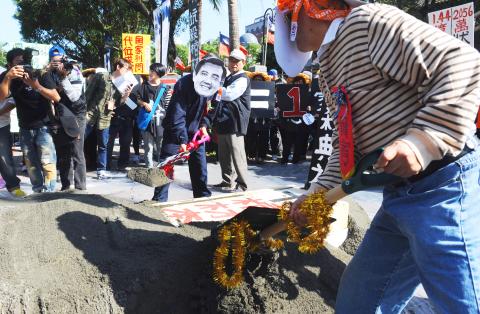
Photo: Lo Pei-der, Taipei Times
“Most of these workers had worked at Lienfu Textile Co — and other companies — for decades, but they were not given proper retirement payment when their employers ran away,” Taiwan International Workers Association researcher Wu Yung-yi (吳永毅) said.
“The council intervened, saying it would pay the workers in the form of loans. It promised then that it would not ask the workers to pay them back, but would get their employers to repay the debt,” he said.
However, 15 years later, the council has filed lawsuits against the more than 400 workers who received payments.
Although the council agreed in August to suspend the lawsuits for four months after repeated protests by the workers and Pan promised to come up with to come up with a solution within a year when he took office early last month, no solution has been forthcoming and the council continues to list the lawsuit budget for the next fiscal year.
“Fifteen to 16 years ago, the workers were owed money by their employers, and now they owe money to the government. It doesn’t make any sense,” unionist Lin Tzu-wen (林子文) said.
“If the council is sincere about solving the problem, it should at least withdraw the budget,” he said.
The council has not only sued those who accepted the loan, but also their guarantors and heirs.
One of the protesters, Lee Tzu-feng (李志豐), 64, said he had nothing to do with Lienfu, but he, along with 30 other members of his family, have all been sued by the council.
“My wife was one of Lienfu’s laid-off workers. She accepted the council’s plan at the time, and asked her mother — my mother-in-law — and my father to be her guarantors,” Lee said.
“Since my wife could not afford to pay the loan, 31 people on my side of the family and on my wife’s side of the family are being sued as we all inherited the debts from my father and my mother-in-law,” he said.
Confederation of Taoyuan Trade Unions chairman Mao Chen-fei (毛振飛) urged the council to respond positively to their demand, “otherwise we’re planning to organize more intense protests.”
In addition to the annual autumn rally on Nov. 25, he said the unions also plan to mobilize workers from across the country to protest before the president on Dec. 31 and Jan. 1 during the New Year celebrations.
“We may throw eggs as well as cow droppings during those protests,” he said.
Several lawmakers, including the Democratic Progressive Party’s Tien Chiu-chin (田秋堇), Liu Chien-kuo (劉建國), Tuan Yi-kang (段宜康) and Yang Yao (楊曜), Taiwan Solidarity Union’s Lin Shih-chia (林世嘉) and Chinese Nationalist Party’s (KMT) Huang Chih-hsiung (黃志雄), have voiced their support for the workers and promised to delete the budget once it is raised in the budget review.
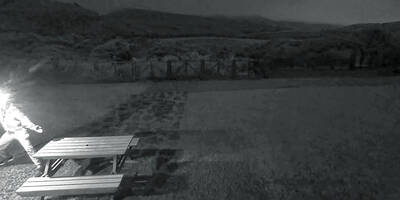
Yangmingshan National Park authorities yesterday urged visitors to respect public spaces and obey the law after a couple was caught on a camera livestream having sex at the park’s Qingtiangang (擎天崗) earlier in the day. The Shilin Police Precinct in Taipei said it has identified a suspect and his vehicle registration number, and would summon him for questioning. The case would be handled in accordance with public indecency charges, it added. The couple entered the park at about 11pm on Thursday and began fooling around by 1am yesterday, the police said, adding that the two were unaware of the park’s all-day live
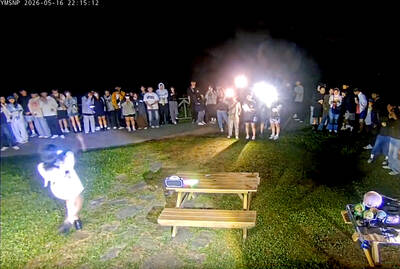
Yangmingshan National Park’s Qingtiangang (擎天崗) nature area has gone viral after a park livestream camera observed a couple in the throes of intimate congress, which was broadcast live on YouTube, drawing large late-night crowds and sparking a backlash over noise, bright lights and disruption to wildlife habitat. The area’s livestream footage appeared to show a couple engaging in sexual activity on a picnic table in the park on Friday last week, with the uncensored footage streamed publicly online. The footage quickly spread across social media, prompting a tide of visitors to travel to the site to “check in” and recreate the

Fast food chain McDonald's is to raise prices by up to NT$5 on some products at its restaurants across Taiwan, starting on Wednesday next week, the company announced today. The prices of all extra value meals and sharing boxes are to increase by NT$5, while breakfast combos and creamy corn soup would go up by NT$3, the company said in a statement. The price of the main items of those meals, if ordered individually, would remain the same. Meanwhile, the price of a medium-sized lemon iced tea and hot cappuccino would rise by NT$3, extra dipping sauces for chicken nuggets would go up

Minister of Digital Affairs Lin Yi-ching (林宜敬) yesterday cited regulatory issues and national security concerns as an expert said that Taiwan is among the few Asian regions without Starlink. Lin made the remarks on Facebook after funP Innovation Group chief executive officer Nathan Chiu (邱繼弘) on Friday said Taiwan and four other countries in Asia — China, North Korea, Afghanistan and Syria — have no access to Starlink. Starlink has become available in 166 countries worldwide, including Ukraine, Malaysia, the Philippines and Vietnam, in the six years since it became commercial, he said. While China and North Korea block Starlink, Syria is not


 RSS
RSS